Masculinity and The Military
By Sawyer Bannister
Theories:
What is Gender?
The military, specifically the US military, is a binary institution in the sense that it has traditionally conceptualized gender as synonymous with two biological sexes: man and woman. However, gender more accurately refers to a set of socially constructed traits associated with masculinity and femininity.
-
West and Zimmerman: “Doing gender means creating differences between” “women and men” “that are not natural, essential, or biological.”[1]
-
Skjelsbæk: “Gender identity is negotiable,” in the sense that “masculinity and femininity are negotiated interpretations of what it means to be a man or a woman.”[2]
What are Masculinity and Femininity?
Masculinity and femininity are complex, context-dependent social identities. Despite their differences, all definitions of masculinity and femininity share a fundamental commonality: a relational status, where masculinity is defined by what femininity is not. Masculinity is constructed in opposition to femininity by devaluing the traits associated with femininity. An example of this is Skjelsbæk and Smith's (2001) explanation of the power and authority of "life-taking" traits over "life-giving" traits.[3]
Men as Life Takers:
Notably, the connection between masculinity and aspects of militarism can be traced back to “early humans” and the original gendered divisions of power: “life-giving” vs. “life-taking” powers.[4] According to scholars, within the “separation of life-giving and life-taking powers,” women were principally responsible for “child-bearing” and “child-rearing,” while men were responsible for protecting their families and communities through “life-taking."[5] From this original division between men and women, definitions of masculinity and femininity developed inextricably with characteristics associated with “life-taking” and “life-giving;” for instance, femininity requires “nurturing, gentleness,” and “passivity,” while masculinity demands “assertiveness,” “ruthlessness,” “confrontation,” and “conquest."[6] Essentially, this theory argues that motherhood is the defining factor of womanhood, while military service defines manhood. Additionally, the association of “life-taking” with masculinity allowed men to garner “authority” over women and femininity; consequently, traits associated with masculinity are considered “the most desirable social values” while traits associated with femininity are “less desirable.”[7]
Scholars argue that “the universality of war” throughout “history and across cultures” as a male-dominated and even a male-exclusive “enterprise” demonstrates how the “nature of life-taking” plays a fundamental role in “defining masculinity.”[8]
Militarism and the Militarization of Masculinity:
Militarism:
Before examining how masculinity becomes militarized, it is critical to understand the concept of militarism. Simply, militarism operates as a “belief system” that extends the logics of war beyond the realm of “war proper” to every facet of “social and political life."[9] Societies that embrace militarism view violence “through a prism of acceptance of the use of force and the valorization of military institutions” and ideologies.[10]
Arguably, militarism serves as the foundation of most modern states. According to Max Weber, a modern state is, by definition, a “human community that (successfully) claims the monopoly of the legitimate use of physical force within a given territory.” [11]
While historically the militarization of masculinity can be traced back to the link between men and “life-taking powers,” in modern states, the link between militarism and masculinity was constructed by “state and military leaders” “for the purposes of waging war.”[12] To construct and maintain the link between militarism and masculinity, leaders promote the belief that the best way for men to develop and showcase the socially desirable traits linked to masculinity, such as strength and bravery, is to serve in the military. Notably, the militarization of masculinity entails devaluing and condemning traits that are stereotypically associated with femininity within the context of the military.[13]
The Militarization of Masculinity:
Under militarism, societal requirements for “being a real man” become connected to traits that are associated with militarized masculinity (aka traits desired in a soldier and military leader), such as aggression, physical strength, assertiveness, and emotionless.[14] In most societies, militarized masculinity is regarded as the 'hegemonic masculinity,' meaning that militarized forms of masculinity represent an idealized form of masculinity that not only positions militarized masculinity as superior to femininity but also as superior to other forms of masculinity. Furthermore, hegemonic masculinity also imposes expectations and even consequences on men and other individuals who do not fit the standard. Research shows that militarized forms of hegemonic masculinity impose a “clear” and “narrow” set of expectations on men, in which they are “expected to be leaders, tough, physically strong, dominant, unemotional and assertive.”[15]
Australian sociologist R. W. Connell coined the term “hegemonic masculinity” to distinguish the “culturally dominant” form of “masculinity” from “subordinated masculinities.”[16] Notably, Connell states that the concept of hegemonic masculinity “grew directly out of homosexual men’s experiences with violence and prejudice from straight men.”[17]
Hegemonic Masculinity: Connecting the Militarization of Masculinity to Militarism
Within this paradigm, while men and masculinity are traditionally associated with militarism, women and femininity are associated with peace. These “Socially constructed gender binaries” and stereotypes, which position femininity in hierarchical opposition to masculinity, devalue femininity and isolate women and girls as “the devalued other[s] needing protection.”[18] This narrative strengthens hegemonic masculinity’s claim to “safety and control” by perpetuating the belief that women rely on men for protection.[19]
What About Femininity?
The gendering of war and peace is rooted in the privileging of life-takers over life-givers in the original gendered division of power. This can be seen in how international security organizations and state militaries favor militarism and militarized masculinity as the only way to achieve peace, often framing it around the idea of protecting women and girls. The result is a militarily patriarchal system that uses violence, and the threat of violence, to maintain the global power order. [20]
Connection to Theory: Masculinity as a Source of Legitimacy? Power?
The narrative that “The US Military Builds Men” contains resonance of Skjelsbæk and Smith’s theory of “life-givers” and “life-takers,” in that the key idea of their theory is that throughout history manhood has been defined by military service. While this narrative is often conveyed explicitly in US military propaganda, it is also implicitly conveyed through imagery of men embodying the ideals of hegemonic masculinity.[21]
PROPAGANDA:
An analysis of US Military propaganda throughout history illustrates that the men included in “film, advertisements, and federal productions” often reflect a very specific type of men – “white, middle class, well-built, straight, and cissexual.” These examples of US military propaganda connect to the idea of state and military leaders actively constructing the link between military service and ideals of masculinity. In fact, research reveals that Americans “rallied their support behind” a version of the US military that was “define[ed] through media” as embodying the “ideal hegemonic male.” Furthermore, by “establishing and reifying an unattainable image of masculinity,” the US military constructed a sense of sanctity surrounding the type of men they included and showcased to the public. Consequently, men and other individuals who did not fit the criteria were not only absent from military propaganda but actually prohibited from service or “denied their economic benefits” when they did serve. This included: “people of color, the working class,” people with disabilities, and members of the LGBTQ+ community. [22]


"The Military Builds Men" Narrative:
Femininity in US Military Propaganda:
While most US military propaganda reflected the ideals of militarized hegemonic masculinity, notably, some wartime propaganda targeted women, such as in World War II. Often, advertisements targeting women awarded them some degree of “strength and power” by portraying women with masculine traits; perhaps the most notable example of this is “Rosie the Riveter.” However, scholars argue that while women were given “masculinity,” implicit in the propaganda images was the idea that women’s masculinity was temporary and that women (and femininity) would always be inferior to men (and masculinity).[25] For example:
“There was an understanding that women could serve the country in a number of ‘masculine’ ways, including enlistment and employment, but the material also came infused with the message that these roles and qualities were temporary and that women were best off at home once the men returned.”[26]

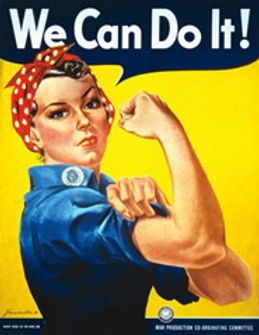
When designing the original 'Rosie the Riveter' poster, there were concerns regarding Rosie's femininity. For instance, a memo from the Office of Emergency Management concerning WAVES and SPAR recruitment stated that “there is an unwholesomely large number of girls who refrain from even contemplating enlistment because of male opinion."[27]
According to scholars, designers of US military propaganda attempted to mitigate this issue by illustrating women in military uniforms while emphasizing their seductive qualities; for instance, conveying that they "could turn on their sex appeal after working hours or excite male lust despite their formidable demeanor." This is noticeable in the subtle hints of makeup on Rosie the Riveter. [28]
Examples of Militarized Masculinity in the US Military:
Historical Context:
As mentioned in the previous sections, the US military maintains an idealized vision of what image the institution wants to portray and who is a member that is rooted in militarized hegemonic masculinity.
The growth of the military-industrial complex at the beginning of World War II marked a turning point for manhood and masculinity in the United States. Research reveals that gender roles and “polarizations” become intensified during times of war as the differences between masculine and feminine traits become increasingly “emphasized.”[29] In this regard, gender roles in America during and following the war were heavily influenced by traditional conceptualizations of gender as well as “an emerging nationalist ideology” known as “the American Way.”[30] Locke explains this ideology as a “set of cultural norms and meanings that emerged” amidst “the threat Fascism and Communism” as well as economic troubles.[31] For instance, military service became revered as a way for men to ascend socially because of the military’s “economic advantages” and high levels of “respect and admiration throughout society.” During this time, military propaganda emphasized the notion that servicemen represented the epitome of bravery and honor by “putting [their] country first.” [32] Overall, the 1950s were a time in US military history in which the militarization of masculinity became cemented throughout American society. Consequently, “the American Way” continued to develop and perpetuate the notion that safeguarding American “freedom and liberty” required the “strength, courage,” and capability of an “all-male military” comprised of men who fit the ideals of hegemonic masculinity.[33]
Modern Day Implications:
Standards: Grooming, Uniforms, Fitness Tests, Etc.:
Various US military standards, such as fitness tests and grooming, reflect the symbolic value the US military places on its tradition and history of brotherhood. These standards are based on historical assumptions of what the military does and do not necessarily hold any value in today’s world. Additionally, many US military standards are based on the military’s binary conceptualization of gender. Although there has been substantial debate in recent years surrounding the decision to embrace gender neutrality in various standards, namely fitness tests, the military’s current standards reflect traditional understandings of men and women.
Army Regulation 670-1: Wear and Appearance of Army Uniforms and Insignia (2021):
"Chapter 3: Appearance and Grooming Policies
3–1. Personal appearance policies:
-
a. Soldiers will present a professional image at all times and will continue to set the example in military presence, both on and off duty. Pride in appearance includes Soldiers’ physical fitness and adherence to acceptable weight standards in accordance with AR 600–9.
-
b. A vital ingredient of the Army’s strength and military effectiveness is the pride and self-discipline that American Soldiers bring to their Service through a conservative military image. It is the responsibility of commanders to ensure that military personnel under their command present a neat and soldierly appearance. Therefore, in the absence of specific procedures or guidelines, commanders must determine a Soldier’s compliance with standards in this regulation."


Males vs. Female Standards:
-
"Wigs and hairpieces. Males are prohibited from wearing wigs or hairpieces while in uniform, or in civilian clothes on duty, except to cover natural baldness or physical disfiguration caused by accident or medical procedure. When worn, wigs or hairpieces will conform to the standard haircut criteria, as stated within this regulation."
-
Cosmetics: "Males are prohibited from wearing cosmetics, except when medically prescribed. Females are authorized to wear cosmetics with all uniforms, provided they are applied modestly and conservatively, and that they complement both the Soldier’s complexion and the uniform. Leaders at all levels must exercise good judgment when interpreting and enforcing this policy."
-
Nails: "Males will keep nails trimmed so as not to extend beyond the fingertip unless medically required and are not authorized to wear nail polish. Females will not exceed a nail length of 1/4 inch as measured from the tip of the finger."
In general, men and women have different grooming standards. Additionally, specific provisions prohibit men from doing things women can do. For example:
Uniform Wear Guidance (2021):


Where do Non-Binary People Fit In?
Gender Neutrality?
One way the inclusion of non-binary people in the US military is addressed is through debates around adopting gender-neutral terminology and practices. In recent years, the discussion around a gender-neutral fitness test has garnered substantial media and political attention. In October 2022, the US Army implemented a new Army Combat Fitness Test (ACFT) after twelve years of research and development; notably, one of the most debated aspects of the ACFT was whether grading should be based on the traditional metrics of gender and age or embrace gender-neutrality and grade soldiers on job-specific requirements. Because research revealed that roughly 50% of women failed gender-neutral fitness tests while their male counterparts easily passed, the US Army decided to maintain its gender- and age-based grading to avoid deterring female recruits. However, on December 6, 2022, it was announced that the impending "National Defense Authorization Act" would require the US Army to amend the ACT within 180 days to establish gender-neutral fitness standards. Notably, gender-neutral is specified as pertaining to men and women within this context rather than reflecting the inclusion of members of the LGBTQ+ community, such as non-binary individuals.[37]
Literature pertaining to gender identities and the US military traditionally centers on binary conceptualizations of men and women. In recent years, discussions regarding transgender people and military service have emerged, mainly within the context of political debates on whether transgender people should be allowed to join the US military. Overall, there is essentially no existing literature or research related to the presence of non-binary people within military institutions or cultures.
Existing Literature/Research?
1. West, C., & Zimmerman, D. H. (1987). Doing Gender. Gender and Society, 1(2), 125–151. http://www.jstor.org/stable/189945
2. Skjelsbæk, Inger and Dan Smith. 2001. Gender, Peace, and Conflict. London: Sage Publications.
3. Ibid.
4. Skjelsbæk, Inger and Dan Smith. 2001. Gender, Peace, and Conflict. London: Sage Publications.
5. Ibid.
6. Ibid.
7. Salla, Michael. 2001. “Women & War, Men & Pacifism” in Gender, Peace, and Conflict edited by I. Skjelsbæk and D. Smith. London: Sage Publications.
8. Skjelsbæk, Inger and Dan Smith. 2001.
9. Sjoberg, Laura and Sandra Via. 2010. “Introduction.” Pp. 1-6 in Gender, War, and Militarism: Feminist Perspectives, by Laura Sjoberg and Sandra Via. Santa Barbara, CA: Praeger
10. Shepherd, Laura J. 2016. “Making War Safer for Women? National Action Plans and the Militarisation of the Women, Peace, and Security Agenda.” International Political Science Review 37(3):324-335.
11. Munro, André. 2013. "State Monopoly on Violence.” Encyclopedia Britannica. Retrieved October 26, 2022 (https://www.britannica.com/topic/state-monopoly-on-violence).
12. Eichler, Maya. 2014. “Militarized Masculinities in International Relations.” The Brown Journal of World Affairs 21(1): 81–93.
13. Ibid; Romaniuk, Scott N. and Joshua K. Wasylciw. 2010. “‘Gender’ Includes Men Too! Recognizing Masculinity in Security Studies and International Relations.” Periodicals by Institute of International Relations, NGO 18(1):23–39.
14. Higate, Paul. 2018. “Men, Masculinity, and Global Insecurity.” Pp. 70-82 in Routledge Handbook of Gender and Security, edited by C. E. Gentry, L. J. Shepherd, and L. Sjoberg. London: Routledge.
15. Stanford University Clayman Institute for Gender Research. 2016. “Men, Masculinity, and the Persistent Nature of Gender Inequality.” Stanford University. Retrieved October 12, 2022 (https://gender.stanford.edu/news/men-masculinity-and-persistent-nature-genderinequality#:~:text=Men%2C%20masculinity%20and%20the%20persistent%20nature%2 0of%20gender,of%20race%2C%20we%20think%20of%20people%20of%20color.).
16. Connell, Raewyn. 2009. Gender in World Perspective. Cambridge: Polity Press.; Connell, Raewyn. 2009. Gender in World Perspective. Cambridge: Polity Press.
17. Connell, R.W. and James W. Messerschmidt. 2005. “Hegemonic Masculinity: Rethinking the Concept.” Gender and Security 19(6):829-859.
18. Romaniuk, Scott N. and Joshua K. Wasylciw. 2010. “‘Gender’ Includes Men Too! Recognizing Masculinity in Security Studies and International Relations.” Periodicals by Institute of International Relations, NGO 18(1):23–39.
19. Åse, Cecilia. 2018. “The Gendered Myth of Protection.” Pp. 273-283 in Routledge Handbook of Gender and Security, edited by C. E. Gentry, L. J. Shepherd, and L. Sjoberg. London: Routledge.
20. Åse, Cecilia. 2018. “The Gendered Myth of Protection.” Pp. 273-283 in Routledge Handbook of Gender and Security, edited by C. E. Gentry, L. J. Shepherd, and L. Sjoberg. London: Routledge.; Skjelsbæk, Inger and Dan Smith. 2001. Gender, Peace, and Conflict. London: Sage Publications.; Eichler, Maya. 2014. “Militarized Masculinities in International Relations.” The Brown Journal of World Affairs 21(1): 81–93.; Tickner, Anne. 1992. Gender in International Relations: Feminist Perspectives on Achieving Global Security. New York: Columbia University Press.; Reardon, B. A. 2019. “Women and Human Security: A Feminist Framework and Critique of the Prevailing Patriarchal Security System.” Pp. 7-36 in The Gender Imperative: Human Security vs. State Security, edited by B. A. Reardon and A. Hans. New York: Routledge.
21. Skjelsbæk, Inger and Dan Smith. 2001. Gender, Peace, and Conflict. London: Sage Publications.
22. Locke, Brandon T. “The Military-Masculinity Complex.” University of Nebraska-Lincoln Department of History. Retrieved October 20, 2022 (digitialhumanities.unl.edu/resources/students/blocke/militarymasculinitycomplex/intro.h tml).; Belmonte, Laura A. Selling the American Way: U.S. Propaganda and the Cold War. Philadelphia: University of Pennsylvania Press, 2010.
23. Locke, Brandon T. “The Military-Masculinity Complex.” University of Nebraska-Lincoln Department of History. Retrieved October 20, 2022 (digitialhumanities.unl.edu/resources/students/blocke/militarymasculinitycomplex/intro.h tml).
24. 1950 Wanted … More Men Like Mike! U.S. Army | Propaganda & Advertising (propadv.com)
25. Locke, Brandon T. “The Military-Masculinity Complex.” University of Nebraska-Lincoln Department of History. Retrieved October 20, 2022 (digitialhumanities.unl.edu/resources/students/blocke/militarymasculinitycomplex/intro.h tml).; Belmonte, Laura A. Selling the American Way: U.S. Propaganda and the Cold War. Philadelphia: University of Pennsylvania Press, 2010
26. Ibid.
27. Pfeiffer, Elisabeth. 2020. "Rosie the Riveter Archive." University of Southern California. Rosie the Riveter Archive (usc.edu)
28. Honey, Maureen. Creating Rosie the Riveter: class, gender, and propaganda during World War II. Amherst: University of Massachusetts Press, 1984. Print.
29. Tickner, Anne. 1992. Gender in International Relations: Feminist Perspectives on Achieving Global Security. New York: Columbia University Press.
30. Belmonte, Laura A. Selling the American Way: U.S. Propaganda and the Cold War. Philadelphia: University of Pennsylvania Press, 2010.
31. Locke, Brandon T. “The Military-Masculinity Complex.” University of Nebraska-Lincoln Department of History. Retrieved October 20, 2022 (digitialhumanities.unl.edu/resources/students/blocke/militarymasculinitycomplex/intro.h tml).
32. Belmonte, Laura A.
33. Locke, Brandon T.
34. US Army. "Army Green Service Uniform: Wear Guide." US Army. Retrieved December 7, 2022. https://www.army.mil/uniforms/
35. "Uniforms: Frequently Asked Questions." US Army. Retrieved December 7, 2022. https://www.army.mil/uniforms/
36. US Army. 2021. "Army Regulation 670-1: Wear and Appearance of Army Uniforms and Insignia." Washington DC: Headquarters Department of Army. https://www.army.mil/standto/archive/2021/01/27/?s_cid=standto?.
37. Beynon, Steve. 2022. "The Army's Fitness Test Might be Revamped yet Again for Gender-Neutral and Job-Specific Standards." Military.com https://www.military.com/daily-news/2022/12/07/armys-fitness-test-might-be-revamped-yet-again-gender-neutral-and-job-specific-standards.html; Beynon, Steve. 2022. "The Army's New Fitness Test is Here. For Real This Time. No, Seriously. But its Future is Uncertain." Military.com https://www.military.com/daily-news/2022/09/29/armys-new-fitness-test-here-real-time-no-seriously-its-future-uncertain.html.