Implementation
by Sonja Woolley
For the military to become fully inclusive, it must work towards changing the institutional barriers that prevent genderqueer service members from serving openly. The gender binary in military culture, and it is true that this cannot be changed by a simple adjustment. However, what the military can do, and is quite good at, is implementing top-down policy. Only after top-down policy which affirms the rights of non-binary service members is implemented, will the culture begin to shift. We’ve seen this happen with the inclusion of transgender service members, policy which has now made it possible to serve openly as transgender and also medically transition while in the service. The Department of Defense issued DoD Instruction 1300.28, effective April of 2021, providing guidance for military departments and reversing Trump-era rules that banned transgender people from serving. The instruction released policies and procedures on several topics:
-
Possibility to transition while serving and receive gender-affirming care
-
Developed procedures for changing one’s gender marker
-
Affirmed that a service member cannot be involuntarily separated, discharged, or denied reenlistment solely on the basis of their gender identity

These progressive changes are relevant to the question of genderqueer/non-binary service members because they a) address the method with which DoD could implement policy and b) open doors for non-binary service members to receive care and change their gender marker.
The Medical System
When discussing implementation of all-gender-inclusive DoD policy, the primary guidance must be aimed at the medical system. Many of the institutional boundaries preventing genderqueer people from serving are represented through the military medical system, which determines several factors which impact a service member’s gender expression. Military service members and families must be registered in the Defense Enrollment Eligibility Reporting System, also known as DEERS, to be eligible for healthcare and other benefits. DEERS is a computerized database of every uniformed service member (whether that be Active Duty, Reserves, or Retired) that functions as “the central source of identity, enrollment, and eligibility verification for members of the uniformed services, other personnel designated by the DoD, and their eligible family members.”[1] Evaluations, fitness assessments, height and weight standards, appearance regulations, living quarters, and many other factors that have huge impacts on how servicemembers live their everyday lives, are based on one’s DEERS profile. Luckily, DoD

Instruction 1300.28 includes guidance on changing one’s gender marker on their profile, taking a step towards inclusivity for transitioning troops. However, DEERS operates on a strict binary – the only two options are MALE and FEMALE, and that’s that. Rebecca Kheel writes for Military.com that “there is no official ban on non-binary Americans serving in the military like there were for gay or transgender troops,” but there is also no official recognition that they exist. [2]
The topic of transgender troops started a conversation about the difference between assigned sex and gender identity, but military guidance still ignores the
existence of genderqueerness, making it especially difficult for non-binary identifying troops to gain access to gender-affirming care. This was the case for Navy Chief Petty Officer Arie Ried, who, when trying to receive care to appear more feminine, had to misrepresent their gender identity:
“For me to get medical support, I had to tell the Navy that I plan to transition from male to female,” Reid said. “There is no conversation about nonbinary.” [3]
If Reid was to walk up to the medical office and openly state that they are non-binary, they would have been denied gender affirming care and given a gender dysphoria diagnosis, provided with only mental health services. And if Reid had made this statement prior to the DoD’s April 2021 update to Trump-era rules and had refused to serve in their ‘biological sex’, they would have been subject to potential separation procedures. [4]
Exceptions to Policy
So far, non-binary servicemembers have been able to express themselves outside of the military’s strict binary policies in select situations when they have an ETP, or exception to policy. ETPs, also called waivers, provide servicemembers with the opportunity to petition their chain of command to be allowed an exception to standard military policy. In most publicized cases, these waivers are related to grooming policy for religious or medical accommodations. Soldiers can request religious accommodations to wear beards, turbans, hijabs, or grow longer hair and can request medical accommodations as well. These ETPs are taken on a case-by-case basis and are granted through an individual’s chain of command, in some cases going up to Brigade-level commanders or to the Secretary level. [5] As one can imagine, navigating this bureaucratic process is notoriously difficult and time-consuming. Additionally, each branch of the military adheres to different standards, so an ETP granted to an airman might not be granted to a marine. The servicemember requesting an ETP has to go above and beyond to demonstrate their reasoning, and requests can be easily kicked back to the beginning of the process for minor problems like formatting errors. Religious ETPs are one of the most institutionally accepted; the DoD Instruction 1300.17 “Accommodation of Religious Practices Within the Military Service” describes the guidelines for which an accommodation will be accepted. And in the case of medical waivers, often relating to medical conditions as a result of excessive facial shaving, grooming standards specifically note the cases by which soldiers could grow a beard (if they are medically exempt from beard grooming standards as a result of Pseudofolliculitis and/or Acne Keloidalis Nuchae), providing soldiers with a clear pathway to receiving an ETP for that accommodation.

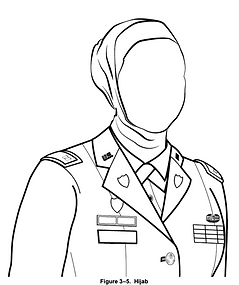
Figures are from Army Regulation 670-1 "Wear and Appearance of Army Uniforms and Insignia" and represent examples of institutionally recognized religious ETPs
There is no clear pathway for ETPs in relation to gender expression. In the foundational DoDI 1300.28, guidance states that “each Military Department and Service may issue policy regarding the application of real life experience (RLE), including RLE in an on-duty status before gender marker change in DEERS.” RLE refers to the phase in which an individual “begins living socially in the gender role consistent with the self-identified gender,” for example, by gender presentation and using certain bathrooms or shower facilities.
This means that non-binary service members get access to ETPs for gender expression purposes only if they have received a medical diagnosis of gender dysphoria and are on the path toward medical transition.
Even after this step, commanders must approve any waivers and, because there is a lack of institutional guidance, this will often come down to the commander’s understanding of gender identity and what they deem ‘necessary’. This lack of official guidance is even more concerning in the context that the American public increasingly believes that a person’s gender is only determined based on their sex assigned at birth, according to 2022 Pew Research Poll shown left. [6] This perception is likely even more extreme in a military climate, which tends to lean conservative. [7]

Policy Changes
The discussion of ETPs is all to say that this process could be and would be substantially different, and even simpler, if the DEERS profile system was changed to include an X gender marker, which would encompass any servicemember or their family members who do not identify within the gender binary. The US government is already moving towards greater inclusion of gender identity on state IDs and passports. In October 2021, the State Department issued its first passport with an X gender marker and has stated that it plans to open up “the gender-neutral option to all applicants next year.”[8] This announcement marked the end of a years-long legal battle on the part of one person, Dana Zzyym, who is an intersex military veteran. Zzyym’s mission has been to break through the binary standard of legal documents requiring only M or F gender markers.

Dana Zzyym’s new passport, courtesy of the New York Times
“In the long run, I started this lawsuit to get legal recognition for intersex and nonbinary people, and I did this for the future,” Mx. Zzyym said on Wednesday.
“For intersex kids to be able to say, ‘Hey, I happen to be a human being who happens to be intersex.’”
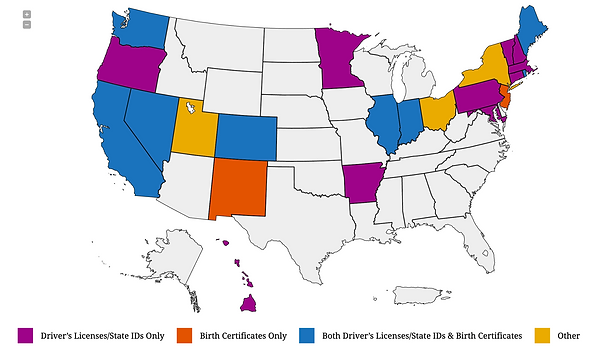
Shown right is a map showing states’ positions on an X gender marker. More than 20 states and the District of Columbia now have the option for a gender-neutral marker on state IDs like drivers licenses. Additionally, more than a dozen states allow an X on birth certificates. If the national ID system can change, so can the DEERS system, and so can the broader military. And it must. The Williams Institute at the UCLA School of Law found in 2021 that about 1.2 million US adults identify as non-binary, about 76% of whom are under age 29. [10] For an all-volunteer force like the US military to continue to have enough personnel, it must strive towards complete inclusivity.
Creating policy that acknowledges the existence of non-binary troops and works to include recruits is imperative. There have been some inclusive efforts taken recently, like the Air Force releasing guidance on the use of pronouns in email signatures and acknowledging that Aviators and Guardians can use they/them pronouns. Bigger change is forthcoming, according to reporting from Military.com. The Pentagon has called for a federally-funded research program on the potential for military troops to be openly non-binary. A similar program was headed by RAND prior to Obama’s lifting of the transgender ban on military service. [11]
The fact that the Pentagon is looking into this demonstrates the acknowledgement that the military needs to be more inclusive and can reach that goal by the inclusion of non-binary identity. A broad policy, like DoDI 1300.28, will need to be implemented and the traditional gender binary of the military will be challenged, but it’s necessary. Aaron Belkin, director of the Palm Center, discussed how inclusion can happen:
“The opponents to nonbinary service, just like they did for Don't Ask, Don't Tell and just like they did for Obama's transgender policy, they're going to insist that implementation is so complicated and so hard, in fact it's so complicated that it can't be done. That's complete bull----," Belkin said. "Implementation is not complicated. Period, full stop. The military could easily pull this off tomorrow.”
1. “Flyer on Registering in the Defense Enrollment Eligibility Reporting System” (DoD and TRICARE, March 2013), https://www.116acw.ang.af.mil/Portals/15/documents/tool_kit/AFD-140813-042.pdf?ver=2016-10-21-132222-673.
2. Rebecca Kheel, “‘I’m Pretty Much Leading a Double Life:’ Nonbinary Troops and the Pentagon’s Next Frontier,” Military.com, February 11, 2022, https://www.military.com/daily-news/2022/02/11/im-pretty-much-leading-double-life-nonbinary-troops-and-pentagons-next-frontier.html.
3. Kheel.
4. “5 Things to Know About DOD’s New Policy on Military Service by Transgender Persons and Per,” U.S. Department of Defense, https://www.defense.gov/News/News-Stories/Article/Article/1783822/5-things-to-know-about-dods-new-policy-on-military-service-by-transgender-perso/https%3A%2F%2Fwww.defense.gov%2FNews%2FNews-Stories%2FArticle%2FArticle%2F1783822%2F5-things-to-know-about-dods-new-policy-on-military-service-by-transgender-perso%2F.
5. “Army Grants Religious Exemptions For Beards, Turbans, And Hijabs,” Task & Purpose (blog), January 8, 2017, https://taskandpurpose.com/news/army-grants-religious-exemptions-beards-turbans-hijabs/.
6. Travis Mitchell, “Americans’ Complex Views on Gender Identity and Transgender Issues,” Pew Research Center’s Social & Demographic Trends Project (blog), June 28, 2022, https://www.pewresearch.org/social-trends/2022/06/28/americans-complex-views-on-gender-identity-and-transgender-issues/.
7. Everett Bledsoe, “What Percentage of the US Military Is Conservative - 4 Sources,” The Soldiers Project (blog), October 2, 2022, https://www.thesoldiersproject.org/percentage-of-the-us-military-is-conservative/.
8. Christine Hauser, “U.S. Issues First Passport With ‘X’ Gender Marker,” The New York Times, October 27, 2021, sec. U.S., https://www.nytimes.com/2021/10/27/us/us-first-passport-gender-x.html.
9. Hauser.
10. Loyal | thisisloyal.com, “Nonbinary LGBTQ Adults in the United States,” Williams Institute, https://williamsinstitute.law.ucla.edu/publications/nonbinary-lgbtq-adults-us/.
11. Rebecca Kheel, “Pentagon Quietly Looking into How Nonbinary Troops Could Serve Openly,” Military.com, January 18, 2022, https://www.military.com/daily-news/2022/01/18/pentagon-quietly-looking-how-nonbinary-troops-could-serve-openly.html