Glimpses into the Facade: Palestinian Activism and Resistance in the Context of Pinkwashing
by Vivienne Arndt
Introduction
Pinkwashing has become an increasingly dominant strategy for states and NGOs to gain political influence by presenting themselves as progressive. Pinkwashing specifically refers to marketing strategies, whether commercial or political, in which an entity presents itself as pro-LGBTQ+ while deflecting from other abuses or discriminatory practices, ones that may negatively implicate the very community they are meant to uplift. Pinkwashing adopts a universal “homosexual” subject as well as an idea of "gay rights" to build a single-issue struggle that suppresses interlocking categories of identity. In contrast, queer movements reject such performative behavior and universalizing practices, instead demanding societal change that is contextualized and substantive.
Since the mid-2000s, Israel has claimed that international progressives, human rights advocates, and queer folks should side with the Israeli state in its war on Gaza since Palestinian society is anti-LGBTQ+. Queer movements in Palestine take on activism and resistance in ways that counter Israel’s pinkwashing by building vibrant LGBTQ+ communities, facilitating social change, advocating for queer issues, and supporting Palestinian liberation. They explicitly challenge single-axis LGBTQ+ activism in favor of transformational queer politics that challenge the forces of homonationalism, heterosexism, and colonization and help disrupt binaries that categorize sexual experience [1]. This disruption suggests how queer movements in Palestine establish an intersectional activist project that critiques colonization, resists co-optation, and reclaims queer Palestinian voices, ultimately countering pinkwashing as an instrument of Israeli state power.
These practices take on additional significance in the Middle East against the backdrop of Western colonialism. Palestinian society is often labelled as “backward,” with a queer population that needs saving by progressive authorities, including the International Lesbian and Gay Association (ILGA) and the Human Rights Commission (HRC) [2]. International human rights advocates are susceptible to the marketing tactics of entities that engage in pinkwashing. According to Manuela Picq, a feminist academic and foreign affairs specialist, international human rights frameworks are incentivized to protect queer populations, but in doing so, often “[erase] ambiguity by creating and imposing particular epistemologies regarding sex, sexuality, and sexual subjectivity,” ones that disregard non-normative modes of sexual expression. International advocates often assess human rights by relying on normative guidelines. In doing so, they depend on universal definitions, like those that portray particular sexual practices as stable identities [3]. Rather than a private or situational practice, sexuality is reconfigured into an identifier that produces a legible group of people that can then be analyzed and ostensibly protected. This shift represents a phenomenon in which sexuality is described in terms of external, often Western frameworks. Projecting LGBTQ+ identity in places where they may not have widespread cultural currency co-opts LGBTQ+ advocacy and minimizes the voices of queer subjects who may not align with identity-based paradigms of sexuality.
In this paper, I explore queer activist movements in Palestine that frame their activism by prioritizing anti-colonial, locally rooted praxis over and against pinkwashing. Exploring the location of activism and resistance reveals insight into norms and the grounding goals of the activist project. By examining queer organizations in Palestine like alQaws, Aswat, and PQ-PDS, I demonstrate how queer Palestinians articulate and challenge the cooperation between feminist, pro-LGBTQ+, and neocolonialist undertakings.
Historical background
Khaled El-Rouayheb, author of Before Homosexuality in the Arab-Islamic World, 1500-1800, describes that prior to the nineteenth century, Arab-Islamic culture did not have a concept of “homosexuality.” Rather, there existed a more diffuse and complex practice of performing erotic desire: one did not “possess” a homosexual identity for engaging in same-sex sexual behavior. Homosexuality as a “self-evident fact about the human world to which a particular culture reacts with a certain degree of tolerance or repression,” was a notion that came much later in history and was exported from Europe to Middle Eastern societies [4]. Under colonial systems, European powers imposed a Western scientific understanding of homosexual identity alongside new anti-homosexuality laws. Thus, many present-day anti-sodomy and anti-homosexuality laws are a product of the colonial experience. For example, the present criminal code in Gaza prohibits same-sex sexual activity under the lingering British Mandate Criminal Code Ordinance 1936 [5]. These laws have had a strong hold in places like Palestine because, at the time in history when European nations began to tolerate homosexuality and reconsider anti-sodomy laws, decolonial movements were on the rise. This meant that for nations subjugated by colonialism, resistance to colonial power also meant resistance to homosexual tolerance, which was viewed as a part of colonial sexual decadence. In many ways, this dynamic has meant that the tolerance of homosexuality has come to represent a pro-colonial position, whereas a return to traditional religion and practice aligns with decolonial efforts.
In modern times, the “Gay International,” a term coined by Joseph Massad to refer to universalizing pro-LGBTQ+ organizations that come out of the US and the West, continues producing homosexual identity where it does not, in fact, exist [6]. When considering pre-colonial performances of desire and sexuality, where there existed a distinction between engaging in homosexual activity and identifying as gay, it becomes clear that assuming categories of sexuality in line with Western scientific understanding is prediscursive and manipulative [7]. By advocating for the “homosexual,” the “Gay International” distorts the identities of the so-called “homosexual” subjects they seek to represent [8]. Progressive movements often enfold the experience of those who are part of distinct social and sexual cultures into their base, speaking for them in order to formulate an expansive activist mission. Massad finds that this dynamic results in “the creation not of a queer planet but rather a straight one” [9]. Pro-LGBTQ+ movements that universalize queer identity ultimately take away the opportunity for individuals engaging in same-sex sex or queer gender expression to define their own movement, instead imposing a Western-constructed pro-LGBTQ+ project and a system of norms that generate and misrepresent identity.
“Brand Israel”
In 2005, Israel began its campaign named “Brand Israel,” which worked in large part to project an image of Israel as a modern and progressive nation, rebranding the state as a safe and welcoming destination for queer people. The city of Tel Aviv was portrayed on gay community websites, Facebook, and Twitter as an “international homosexual vacation destination” and “gay capital,” receiving various awards for its work towards inclusion and equality [10, 11]. In addition to highlighting the quality of lives lived in Israel, Prime Minister Benjamin Netanyahu denigrated the rest of the Middle East as “a region where women are stoned, gays are hanged, Christians are persecuted” [12]. From this effective contrast, Israel gained a helpful tool to leverage in public relations.
Pride Celebration, June of 2022 in Tel Aviv [13].
The rebranding came as an attempt to “prove” Israel’s commitment to human rights; however, public branding shifts have not been aligned with improvements in rights or quality of life for queer people. For example, gay marriage is still outlawed in Israel. While same-sex couples who are married in another country can register as married in Israel, they cannot become legally married in the state, and they may not necessarily receive the same rights as heterosexual couples, including access to a surrogate pregnancy or automatic recognition of non-biological children [14]. According to Aeyal Gross, Professor of Law at Tel-Aviv University, “Brand Israel has not changed the fact that ‘conservative and especially religious politicians remain fiercely homophobic’” [15]. Recently, Netanyahu’s party even signed a deal offering an Israeli government position to Avi Maoz, an openly homophobic and ultra-nationalist politician [16]. Additionally, the Israeli government has remained passive on issues related to anti-LGBTQ+ hate and violence. In a 2022 report by an LGBTQ+ association in Israel, it is revealed that in that same year, there were 3,309 reports of LGBTQ+ abuse and violence, a steep increase from previous years. This number reflects a sevenfold increase in LGBTQ+ abuse by public figures and the media [17].
In denying the real threat of anti-LGBTQ+ hate, the Netanyahu administration neglects the well-being of queer people and threatens the safety of its LGBTQ+ population. These actions starkly contrast with the administration’s avid messaging in favor of the rights of LGBTQ+ people, indicating that the country’s commitment to these rights is shallow. Looking at the supposedly accepting culture of Tel Aviv or the inclusion of LGBTQ+ individuals in the Israeli military indicates very little about the broad state of human rights in Israel. What these markers do reveal is that the nation has repackaged its image and exploited Israeli and Palestinian LGBTQ+ experiences for its own political leverage [18].
Co-opting the Queer Palestinian
Necessary to Israel’s pinkwashing mission is the portrayal of Palestinian society as the unmodern, homophobic other. Israel benefits from telling a story of Palestinian backwardness and imposing standards for modernity that they don’t meet themselves. This political mechanism by the Israeli state is a good example of homonationalism. This theory describes when a state poses as modern and liberatory in opposition to supposedly unmodern and homophobic societies, ones that do not meet Western democratic ideals for sexuality and gender (for a more thorough definition and analysis of Homonationalism, see Mary Martin’s case study on Hungary). Although anti-sodomy and anti-homosexuality laws were first imposed in places like Palestine by colonial authorities as part of their “civilizing” mission, when Israel dominates the narrative about the identity and treatment of queer people in Palestine, crucial context is lost concerning the Western, not Islamic, origins of homosexual regulation. Israel continues to paint Palestinian, Arab, and Muslim societies as entirely backward and intolerant in comparison to their own modern culture [19]. The idea of a misogynistic and homophobic Palestine allows Israel to gain leverage by portraying queer individuals in Palestine as endangered by their own culture.
Imposing these narratives about the Palestinian people and instilling fear concerning the mistreatment of queer folk in the Middle East fits together with Gayatri Spivak’s understanding of colonial saviorism, set forth in “Can the Subaltern Speak?” Spivak’s model begins with understanding a certain group as naturally victimized, backward, and without agency. This ties into the concept of “white homosexuals saving brown homosexuals from brown homophobes,” [20] which captures colonial logic that claims that colonized subjects are naturally oppressed by their own socio-political systems and can be bettered by Western modernizing missions. The state-led Israeli queer movement that seeks to liberate the Palestinian “homosexual” relies on Western construction of gender and sexual identity as a ground for coalition building without taking into account colonial subjugation or indigenous customs of gender and sexuality. In this way, pinkwashing activities take away the voice of subaltern subjects by enveloping their experience within Western constructions of sexual identity and immediately taking as victims those queer individuals who have unique experiences of oppression within an occupied society.
Israel’s pinkwashing efforts intensify the colonial sexual epistemologies critiqued by El-Rouayheb and Massad. Israel takes cultural prominence away from queer people in Palestine by monopolizing the “saved” and legitimized homosexual subject, one that, as a result of “Brand Israel,” can only exist within the nation’s borders. They frame a gay subject that can be clearly categorized as “homosexual” and who has been saved and secured by the state itself. As put by Sukrita Lahiri, author of Anti-Pinkwashing as Emerging Hope: Queering the Palestinian Liberation Movement in the Context of Institutionalised Neoliberalism, Israel’s messaging about the treatment of queer people in Arab nations has effectively contributed to the “non-acknowledgement of the existence of a legitimate Palestinian homosexual – unless they exist within the borders of the state of Israel, where they are constructed as ‘rescued beings. [21]’” Israel’s construction of the Palestinian queer individual, removed from political and cultural context, appropriates Palestinian experiences to build its pro-LGBTQ+ narrative. The selective inclusion of certain “inoffensive” queer bodies [22], which are often white, wealthier, and exist within Israeli borders, further indicates the performative nature of Israel’s LGBTQ+ activism. In effect, the Israeli state colonizes Palestinian sexual politics, creating a movement that is straight by nature and takes prominence away from queer Palestinians whose experiences and history cannot be rashly incorporated into Western models of homosexual categorization or colonial saviourism.
Israel has also created material constraints that physically limit the mobility of Palestinian queer individuals and organizers. Through checkpoints and other barriers, the Israeli government restricts movement, leading director of alQaws, Haneen Maika, to describe that “While Palestinians in Israel, Jerusalem, and the Occupied Territories of the West Bank and Gaza constitute one community, our different legal statuses and the different realities of each of these locations – including, for example, restrictions on the freedom of movement of Palestinians from the West Bank and Gaza – severely constrain our ability to meet as a community. [23]” The design meant to obstruct Palestinian queer folks from travelling to meet with fellow activists fits well under Israel’s pinkwashing framework that suppresses Palestinian voices and fragments communities [24]. This process attempts to inhibit collective mobilization and strip individuals of physical autonomy by denying them the right to organize across certain boundaries. These activities allow Israel to function in another way as the “gatekeeper” of the Palestinian queer cause. They maintain control over when and how these movements may receive representation [25]. Therefore, pinkwashing in Israel effectively co-opts the pro-LGBTQ+ movement in ways that legitimize their colonial prospects, distort their own discrimination, and limit the authority of queer people in Palestine.
Palestinian Resistance Movements
Palestinian liberatory groups highlight the dangers of pinkwashing and the fact that Israel is not the pro-LGBTQ+ state it claims to be. One of these organizations is alQaws. AlQaws, which means rainbow in Arabic, was founded in 2007 and emerged from the Palestinian feminist movement, which combined advocacy for the liberation of women and of the Palestinian nation [26]. In addition to supporting and engaging queer individuals, alQaws counters Israel’s pinkwashing. As a part of its mission, alQaws challenges the imposed idea that the Palestinian identity is incompatible with queerness and that Muslim authorities endanger queer Palestinians. As such, the organization reemphasizes queer Palestinian identity in order to help others understand how queer identity is constructed in occupied societies [27]. AlQaws describes the complicated effect of Israel’s pinkwashing: “we can either be queer and not accepted as a Palestinian, or we can be Palestinian and not accepted as queer” [28]. Their advocacy seeks to dismantle this internalized dichotomy in order to empower queer Palestinians and recall a complex indigenous experience of queerness foundational to Palestinian activism.
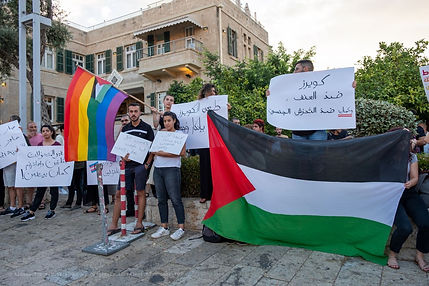
Demonstration in August of 2019 in Haifa, Palestine. Activists are holding signs calling for an end to Pinkwashing as violence and the physical and psychological violence against LGBTQ people [29].
In order to rearticulate queer Palestinian identity and build a strong LGBTQ+ community, alQaws promotes art, music, and humor that embody lived experience [30]. These unique forms provide an opportunity for those with marginalized identities to reconcile their lived experience in an occupied state through modes that are not co-opted by the Israeli-led movement. Many examples of queer Palestinian organizing fall into this category. In one act of independent activism, 300 LGBTQ+ Palestinian artists signed a letter that jointly condemned pinkwashing and Israeli occupation [31]. Queer organizers boycott Israel-led LGBTQ+ efforts as a way to address Israeli nationalism and colonialism. In practice, one example of this is when over 100 LGBTQ+ groups supported a boycott of Eurovision 2019, causing many queer artists and filmmakers to withdraw from TLVFest, the LGBTQ+ film festival in Tel Aviv [32].
Opening Night of the TLVFest 2022 [33].
Grassroots networks also amplify subaltern voices through avenues that are not controlled by Israeli and Western powers. In this way, activists can work outside the systems that attempt to define and appropriate their identities and experiences. These strategies build a foundation that allows subaltern voices to be heard via collective struggle. Part of alQaws’s mission is to directly empower community members to become local and national activists while also building strong cultural infrastructure on the issue of LGBTQ+ diversity [34]. Improving queer Palestinian visibility is a step towards ensuring movements that address queer issues can’t be co-opted by outside authorities. AlQaws helps queer Palestinians develop access to networks of advocacy and fortified communities in which their identity is recognized and they may represent their own voices. Activist efforts that subvert the pro-LGBTQ+ project of the Israeli state help reveal that queer liberation in Palestine needs to be accomplished alongside the end of Israeli occupation; otherwise, the Israeli state will perpetuate both co-optive and violent tactics to maintain colonial rule. Crucial to an understanding of alQaws’ movement is also the notion that Israel’s colonial violence is directly tied to violence against LGBTQ+ people in Palestine, for example, LGBTQ+ Palestinian advocates cite the threat of an Israeli bomb as greater than any vulnerability to violence that derives from their queer identity” [35].
Other coalitional organizations like Aswat focus particularly on “enhancing the visibility of and empowering Palestinian LBTQIA+ women and trans [sic]” [36]. Aswat attempts to build safe places for activism by Arab and Palestinian gay women. Rather than accepting Israeli narratives that universalize lesbian women as passive victims of patriarchy or gender-based violence, Aswat creates avenues for women to be active agents of political resistance [37]. The Palestinian Queers for Boycott, Divestment, Sanctions (PQ-BDS) similarly helps build queer solidarity within anti-occupation activism [38]. Part of the strategy centers queer and trans Palestinian lives rather than tokenizing these identities. Yaffa A.S., a trans Indigenous Palestinian, says that “...every aspect of our being is being weaponized against our own community. Through centering our voices we not only disrupt the pinkwashing narrative but we move beyond it” [39]. These voices help counter pinkwashing propaganda, which paints queer people as helpless victims of oppression. In doing so, they allow for new developments in liberation where individuals can reemphasize identity and amplify their authentic voices via collective struggle.
Many of the activities of these Palestinian organizations fit into the framework Picq outlines for queer politics. Picq, in Sexualities in World Politics, differentiates between “LGBT advocacy” and “queer advocacy.” Whereas “LGBT advocacy is aimed at inclusion within existing forms of representation,” queer tactics “subvert heteronormative policies” and appreciate differences [40]. In this way, they starkly contrast with homocolonialist authority by functioning outside of Western colonial systems. This praxis is valuable to anti-pinkwashing resistance by suggesting the development of activism and representation that exists outside of oppressive systems. For example, Lahiri finds that queer Palestinian organizations often “resist the dominant international LGBT rights agendas and paradigms like legalisation of same-sex marriages” [41]. Instead of leaning into colonial measures of progress on LGBTQ+ issues, these organizations queer resistance by generating collective queer communities and gender and sexuality-diverse society [42]. Organizations like alQaws embody Picq’s approach through political and social strategies that build local grassroots activism and name the pinkwashing activities that distort queer Palestinian identity and attempt to fragment the queer movement. By also working to build a thriving LGBTQ+ community, alQaws, Aswat, and PQ-BDS help Palestinian queers reclaim expressions of sexuality and gender against colonial, heterosexist, and homonationalist frameworks [43]. The methods of the above organizations help queer Palestinians dispute imposed narratives and allow them to call out the performativity and misclassifications of Israeli activism.
Protest by BDS forces against Israeli pinkwashing [44].
In “The Road from Antipinkwashing Activism to the Decolonization of Palestine,” Lynn Darwish and alQaws’ Maikey describe that anti-pinkwashing activism exists “at the intersection of lesbian, gay, bisexual, trans, and queer movements and the Palestine solidarity movement” [45]. The interaction of these movements links anti-pinkwashing efforts to anticolonial ones as it involves the rejection of multiple, overlapping forms of oppression [46]. By illuminating the miscategorizations and false promises of progress that uphold pinkwashing, these coalitional activist movements work to expose how states co-opt queer experiences and suppress LGBTQ rights.
Effective queer Palestinian activism does not merely pursue advocacy on the grounds of queer identity, but also involves conditions of colonial occupation and racialization that structure social contexts and experiences of oppression. This particular recognition prevents the queer Palestinian subject from being co-opted into the universalized narrative of Israel’s pro-LGBTQ+ movement. Organizations like alQaws, Aswat, and PQ-BDS practice intersectionality by resisting multiple overlapping forces of oppression; they not only counter homophobia and patriarchy, but also neocolonialism and Western dominance in the framing of queer issues. By addressing these issues together, they also historicize and expose Israel’s pinkwashing as a tool of colonial subjugation.
Conclusion
Pinkwashing is an inherently paradoxical and fragile mechanism, such that it may crack when directly confronted. Pinkwashing strategies rely on a facade of liberation that may be disrupted by exposing lived realities and highlighting social and political contexts that have been effectively obscured. Activist movements in Palestine have the opportunity to resist the co-opting of their voices and build coalitions by exposing these contradictions and proposing alternative avenues of advocacy that are community and context-specific. Because the forces of patriarchy, sexual oppression, and colonial cooptation are linked in Israel’s conduct towards Palestine, fighting against any one of these fronts means countering all of them. Therefore, collective liberation becomes even more important to Palestinian organizers, as seen through alQaws, Aswat, and PQ-BDS, which confront LGBTQ+, feminist, and colonial oppression. Pinkwashing tactics can undermine activism by dividing communities and imposing overly general or inaccurate understandings of identity. Collective liberation, in contrast, lays the groundwork for self-determination that can allow individuals to rearticulate their identity and forge communities that embody agency and autonomy.
Works Cited
1. Oliver, Melia. “Rainbow-Washing the Occupation: A Critical Examination of Israeli Claims to Feminist and Gay-Friendly Modernity, ” Scripps College, 2024. https://scholarship.claremont.edu/cgi/viewcontent.cgi?article=3452&context=scripps_theses.
2. Joseph Andoni Massad, “Re-Orienting Desire: The Gay International and the Arab World,” Public Culture 14, no. 2 (2002): 361
3. Lavinas Picq, M., & Thiel, M. Sexualities in World Politics: How LGBTQ claims shape International Relations. Routledge (2005). https://doi-org.ccl.idm.oclc.org/10.4324/9781315743721
4. Khaled El-Rouayheb, Before Homosexuality in the Arab-Islamic World, 1500-1800 (Chicago: University of Chicago Press, 2005), 5
5. Human Dignity Trust. “Palestine.” December 17, 2024. https://www.humandignitytrust.org./country-profile/palestine/.
6. Massad, “Re-Orienting Desire.” 363
7. Ibid., 373
8. Ibid., 363
9. Ibid., 385
10. Lahiri, Sukrita. “Anti-Pinkwashing as Emerging Hope: Queering the Palestinian Liberation Movement in the Context of Institutionalised Neoliberalism.” Pluto Journals, International Journal of Critical Diversity Studies , vol. 3, no. 2 (2020): 53–72.
11. Mondoweiss. “A Documentary Guide to ‘Brand Israel’ and the Art of Pinkwashing.” November 30, 2011. https://mondoweiss.net/2011/11/a-documentary-guide-to-brand-israel-and-the-art-of-pinkwashing/.
12. Lahiri, “Anti-Pinkwashing.”
13. PHOTO CREDIT Westerman, Kim. “Tel Aviv, ‘Gay Capital Of The Middle East,’ Welcomes Return Of Pride Celebration June 8th-12th.” Forbes, June 4, 2022. https://www.forbes.com/sites/kimwesterman/2022/06/04/tel-aviv-gay-capital-of-the-middle-east-welcomes-return-of-pride-celebration-june-8th-12th/.
14. Nefesh B’Nefesh. “LGBTQ and Same-Sex Couples in Israel.” https://www.nbn.org.il/life-in-israel/government-services/lgbtq-and-same-sex-couples-in-israel/.
15. Mondoweiss. “A Documentary Guide.”
16. Netanyahu Signs Israel Coalition Deal with Anti-LGBT Noam Party. November 28, 2022. https://www.bbc.com/news/world-middle-east-63780509.
17. For Israel’s LGBTQ Citizens, Threats Are No Longer Theoretical – A Wider Bridge. n.d. Accessed December 3, 2025. https://awiderbridge.org/for-israels-lgbtq-citizens-threats-are-no-longer-theoretical/.
18. Mondoweiss. “A Documentary Guide.”
19. Elia, Nada. 2018. “Don’t Try to Stop Us from Denouncing Israel’s Pinkwashing.” Middle East Eye, April 19, 2018. https://www.middleeasteye.net/opinion/dont-try-stop-us-denouncing-israels-pinkwashing.
20. Rao, R. (2010) Third World Protest, Oxford: Oxford University Press. DOI: 10.1093/acprof:oso/9780199560370.001.0001
21. Lahiri, “Anti-Pinkwashing.”
22. See Mary Martin’s case study.
23. The Guardian. “Rainbow over Palestine.” Opinion. March 10, 2008. https://www.theguardian.com/commentisfree/2008/mar/10/rainbowoverpalestine.
24. Lahiri, “Anti-Pinkwashing.”
25. Aldossari, Maryam. “For Feminists, Silence on Gaza Is No Longer an Option.” Al Jazeera. Accessed December 2, 2025. https://www.aljazeera.com/opinions/2024/1/4/for-feminists-silence-on-gaza-is-no-longer-an-option.
26. Atshan, Sa’ed. “Introduction: There Is No Hierarchy of Oppressions”.” In Queer Palestine and the Empire of Critique. Stanford University Press, 2020. https://www.degruyterbrill.com/document/doi/10.1515/9781503612402-003/html.
27. Lahiri, “Anti-Pinkwashing.”
28. “Beyond Propaganda: Pinkwashing as Colonial Violence.” Accessed December 2, 2025. https://www.alqaws.org/siteEn/print?id=86&type=1.
29. PHOTO CREDIT “Palestinian Voices Condemn Violence Against LGBTQ People.” Accessed December 2, 2025. https://www.alqaws.org/news/Palestinian-Voices-Condemn-Violence-Against-LGBTQ-people?category_id=0.
30. Lahiri, “Anti-Pinkwashing.”
31. Youngblood Gregory, Sara. “No Pride in Genocide: Calling Out Israel’s Pinkwashing.” Yes!, February 2024. https://www.yesmagazine.org/social-justice/2024/02/05/israel-palestine-gaza-genocide-queer#:~:text=Meanwhile%2C%20a%20collective%20of%20queer,%2C%20Palestine%20will%20be%20free.%E2%80%9D&text=Sara%20Youngblood%20Gregory%20is%20a,in%20touch%20at%20saragregory.org.
32. “Say No To Pinkwashing | BDS Movement.” Accessed December 2, 2025. https://bdsmovement.net/pinkwashing.
33. PHOTO CREDIT Opening Night of the TLVFest 2022. October 31, 2022. https://tel-aviv.czechcentres.cz/en/blog/2022/10/zahajeni-tlvfest-the-international-tel-aviv-lgbtq-film-festival
34. “About Us.” Accessed December 2, 2025. https://alqaws.org/about-us.
35. Rummler, Orion. “Why These Queer Americans Want LGBTQ+ Groups to Back a Cease-Fire in Gaza.” The 19th, March 6, 2024. https://19thnews.org/2024/03/lgbtq-americans-gaza-israel-protests/.
36. Lahiri, “Anti-Pinkwashing.”
37. The Sigrid Rausing Trust. “Aswat – Palestinian Gay Women.” May 18, 2010. https://www.sigrid-rausing-trust.org/grantee/aswat-palestinian-gay-women/.
38. Stelder, Mikki. “Other Scenes of Speaking: Listening to Palestinian Anticolonial-Queer Critique.” The Sigrid Rausing Trust. “Aswat – Palestinian Gay Women.” May 18, 2010. https://www.sigrid-rausing-trust.org/grantee/aswat-palestinian-gay-women/.
39. Youngblood Gregory. “No Pride in Genocide.”
40. Picq. Sexualities in World Politics.
41. Lahiri, “Anti-Pinkwashing.”
42. Ibid.
43. “Beyond Propaganda”
44. PHOTO CREDIT “Say No To Pinkwashing.”
45. Darwich, Lynn, and Haneen Maikey. “The Road from Antipinkwashing Activism to the Decolonization of Palestine.” Women’s Studies Quarterly 42, no. 3/4 (2014): 281–85. http://www.jstor.org/stable/24365011.
46. Oliver. “Rainbow-Washing the Occupation.”